Showing posts with label Books. Show all posts

Wednesday, December 18, 2013

The Selfish Swami & Other Stories

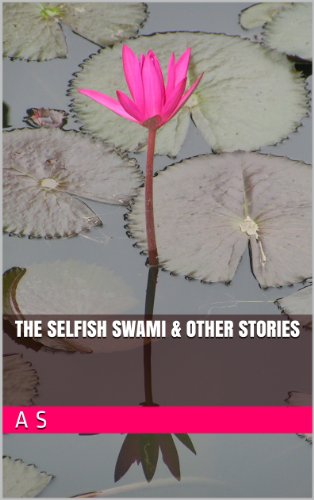
The Selfish Swami & Other Stories Thanks to the support and encouragement of all my readers over almost a decade, I have finally published my first book: The Selfish Swami & Other Stories. The book has been published with the pen name: A S. It is a collection of short stories involving the following common and uncommon situations, and more! What happens when:
  • You get a chance to date a movie star you admired during your childhood?
  • You are stood up on a blind date and you notice another person's blind date go awry?
  • You are married and are unexpectedly visited by your college crush?
  • You are on a new date and you get an urgent call of nature with no facilities anywhere near by?
  • You fall head over heels for a girl, only to discover that she is in love with another man whom you could never hope to match?
In 10 entertaining short stories written over a period of 15 years, I invite you to follow an eclectic mix of Indians in their pursuit of love and passion, ranging from blind dates to paid encounters, extramarital trysts to arranged marriages, teen romance to spiritual love. Seamlessly switching between first person and third person narratives, as well as male and female voices, these stories are quintessentially Indian in language and spirit. A perfect little book to accompany your cup of chai or coffee on a relaxing evening. Pick up a copy for yourself, consider gifting it to a friend, and please do tell everyone about it!

This is an ebook available on Amazon.com. You can read it on your favorite device - a laptop or a desktop, a tablet or a smartphone, or on all of them! You can start reading on once device, and pick up exactly where you left off on an different device. If you have not read an ebook from Amazon before, you can click here to find the best option by which you can read my book on your favorite device.

Wednesday, December 24, 2008

The White Tiger - Book Review

The White Tiger Cover This year's Booker Prize winning novel, The White Tiger, by Indian writer Aravind Adiga, starts off in an unusual format - as a letter or series of letters from a small-time Indian entrepreneur, addressed to Wen Jiabao, the Premier of China. The premise is that Balram Halwai, the Bangalore-based entrepreneur, hears on the radio about the Premier's impending visit to India, to learn about how India produces so many entrepreneurs, the one thing in which China has not surpassed India, and he takes it upon himself to educate the Premier. Based on the mood and tone of the first few pages, you'd expect to read the story of how a person becomes one of the millions of successful entrepreneurs in India, who have propelled the country into being the second fastest growing economy in the world. A story narrated with wit, sarcasm and dark humor. And that is what you get.

But you also get more. You get an utterly realistic, ugly and depressing view of Indian society, through the eyes of one of its poorest sons as he goes through his life. From growing up in a remote North Indian village, attending a pathetic school, to being pulled out of school at the age of eight to work in a tea shop, to becoming the chaffeur for a rich family, to committing a heinous crime to the capital for her entrepreneurial venture, to becoming a successful, scrubbed entrepreneur running a cab company in India's tech capital, Bangalore. That's the entire story of the novel in one sentence. And no, it is not the story of the courage and heroism of an unfortunate person who rises up in life through honest hardwork and determination. And no, it is not an uplifting story by any stretch of the imagination. There is nothing to be proud of in the novel - not the country, not its society, not its economy, not the booming technology sector, not the upper classes, not the lower classes, not even the observant, determined, quick-learning, ultimately successful protagonist, Balram Halwai.

The author, Aravind Adiga, keeps the first person narration simple and straight-forward. There are no narcissistic attempts at showing off his literary skills. No self-indulgent prolonged critiques and philosophical narratives. The few places where the author attempts to explain concepts about Indian society - examples include the caste system and the 'Rooster Coop' (the coop in which hens to be slaughtered are packed tightly and where they remain quietly, unprotesting) metaphor for the Indian society with its quietly subjugated population - are handled with pithy simplicity.

The author exhibits a remarkable skill in observing and narrating the story through the eyes and heart of a servant. Quote from the book: "Do we loathe our masters behind a facade of love - or do we love them behind a facade of loathing?". He also shows a similar skill in the characterization of the people who fill the story. At one point, Balram Halwai, the servant-driver, says how he would never buy a t-shirt, like the one his master wears because it is mostly white with a small, simple design on the front. To get his money's worth, he would buy a very colorful shirt, filled with as much designs and patterns as possible. While the characterization is believable, the transformation of Balram from a suppressed servant to a ruthless criminal is somewhat abrupt and hard to accept. Despite the fact that he is portrayed to be different (a white tiger!) from the other boys and men his entire life. Perhaps, I'm simply used to reading and seeing heroes in most books and movies going through great misery and pain before they've had enough and decide to fight back.

There are some poignant moments in the story like the time Balram, the chaffeur, counsels and consoles his broken master on the side of a road, using his own home-brewed cocktail of morals and philosophies, some picked up in his childhood village and some made-up on the spot. At that point in the story, he compares himself to THE famous chaffeur from India - Lord Krishna Himself, who narrated the great Bhagavad Gita to a broken and self-doubting Arjuna. It is this kind of wit and humor from the protagonist, which keep the book from becoming a dark and depressing read. This is also the author's greatest strength. It makes the book very readable and keeps it moving at a steady clip. One could easily finish the book in one or two sittings.

I like that the author keeps things gritty and real without being too dramatic or preachy, without being moralistic or taking sides too obviously. I like that he does not seem to indulge in the cardinal sin of many Indian writers and movie directors - playing to the Western galleries with a mix of exaggerated and exotic portrayal of all things Indian. Unless you consider the entire novel to be one big play for the Westerners. I don't think it is. But I am a little disappointed because I did expect the novel to be representative of the story of a typical (tech) entrepreneur from Bangalore, a story that needs to be told, a story I'd love to read. I did not expect a story, which when described in one sentence, sounds like it is straight out of a typical Indian movie! Despite that, I do recommend this book. It is a valuable and realistic snapshot of the current state of Indian society, with all its class differences, misery and corruption, juxtaposed against the tech boom and economic growth. For that it's well worth a read - especially to my fellow, young Indians.

Friday, September 08, 2006

Londonstani - Book Review

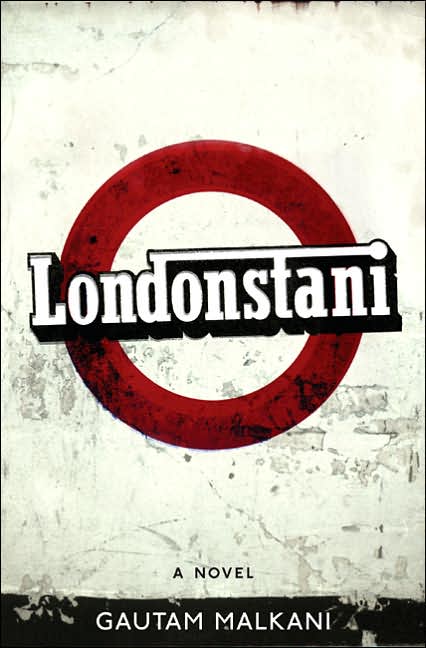
Londonstani CoverJust finished reading Londonstani by Gautam Malkani. It is a novel, giving fascinating glimpses into the NRI (non-resident Indian) community in London, UK. Although it is a novel, I hope to god the author is not too off the mark in his portrayal of the NRI community because we, the general readers, can't help thinking of novels such as these as the real windows into a community of people.

I am more familiar with the NRI community in the US, particularly the young immigrants (not so affectionaly called FOBs, fresh off the boat), being one myself. So, I found it really interesting to read about the Indian community in the UK, the young kids and adult Indians who were born there, and their immigrant parents. The similarities and differences between the Indians in India, the UK and the US was indeed fascinating. I will not try to list here the similarities and differences I noticed, because that is not the point of this blog post. Moreover, your own list might vary significantly from mine. Nevertheless, I always like to read about contemporary Indians, wherever they are.

The main protagonist of Londonstani is Jas, who narrates the story in first person, using what is supposed to be London's desi slang, as his preferred language. The story is of Jas and his three friends, who are all somewhere close to 20 years of age. None of them are doing well in their studies, and just seem to be drifting along in life. They have a small cell-phone operation, which is not exactly legal. However, their small caper leads them into something unexpectedly big-time, before ending in a somewhat lame climax. En route, we get to witness immigrant life in London: the attitudes of the younger generation versus their parents, the relationship dynamics within families, the dynamics between the youth, influenced by their religion and gender, assimilation issues, identity and young manhood issues, etc. The story includes all the typical elements of an Indian movie: youthful mischief, budding romance, marriage, death, funeral, family fights, actual physical fights between guys and even a suave, intelligent villain who is as bad and manipulative as any movie villain. Despite all that, it is not really a typical Indian movie story.

I felt that the novel was a little slow in clearly establishing the identities and personalities of three of the four main characters. Hardjit, the Punjabi body-builder and wrestler, is the only character who gets assertively delineated early on. Even the main protagonist, Jas himself, takes some to come out of the fuzzy vision. May be that was deliberate and is in line with the personalities of the characters.

The writing is funny and witty, especially in its observation of the many unique characteristics and quirks of Indians, their attitudes, beliefs, their lives. However, there were many occasions when I was reading the book and I thought, "This is supposed to be funny, I should really be laughing hard at this, but why am I not?" I still don't know why I was not laughing hard, although I did chuckle and smile quite frequently. The description and explanations in the desi-ghetto slang, that too from a youthful perspective, was supposed to be half the fun. But may be it was this very slang which prevented me from fully empathizing with the narration and laughing hard, or may be it was something else. May be other readers might have indeed laughed harder. Nevertheless, I did get the feeling sometimes that the author was trying too hard to be funny or to make a point or to describe something.

In at least two chapters, the author uses a mixed-timeline narrative style. In the dance club chapter, the narration skips back and forth over events which take place on two consecutives evenings. Towards the end of that chapter, the back and forth switch between the two evenings is more rapid, until at the very end, they actually seem to blend together. (SPOILER WARNING: Rest of this paragraph!) In the funeral chapter, you think you are reading about events that took place at one point of time, but when you reach the end of the chapter, the author displays a sleight of hand, and you realize that you are actually reading about events which happened at least a couple of weeks later.

This unexpected sleight of hand by the author is again evident at the very end of the story, a surprising twist in almost the penultimate page. The climax is kind of lame, but the twist which follows, tilts the whole story a bit. I finished reading the novel late last night and the twist has still not fully sunk into my mind this afternoon. In many good novels which have a final twist in the tale, that last surprise causes the main piece or many pieces of the puzzle to fall in place, explains many things, and neatly ties up the story for us. The final twist in Londonstani is probably supposed to do that, but it has quite not done that for me. I don't know why that twist was necessary.

Despite the ending, Londonstani was an entertaining novel to read.
Thursday, August 10, 2006

The Red Carpet - Book Review

Read Lavanya Sankaran's The Red Carpet - Bangalore Stories recently. It is a collection of short stories, all of them set in Bangalore.

It is only incidental that the stories take place in Bangalore. They might as well have taken place in any big city of South India, or for that matter, even the North. Most of the stories, except for the title story The Red Carpet itself, are about Tamil Brahmin (Tambram) Iyer families. As such the stories are more about contemporary Tambrams, than about anything to do with Bangalore.

The occasional appearance of Kannada words and phrases in the stories seemed contrived, where as, the Tamil words seemed to blend in nicely. In fact, one of the Kannada phrases was not even grammatically correct. If you belong to an upper middleclass non-Kannadiga family in Bangalore, it is quite possible for you to grow up in Bangalore without really becoming fluent in the local Kannada language.** I suspect the author Lavanya Sankaran might be one of those.

The stories themselves are very well written. They effortlessly pull the reader into the lives of the characters. I found myself empathizing with the hopes and dreams and pains and fears of the characters even before reading through the first page of each story. For me, the most touching story was "Mysore Coffee", about Sita, a working girl who is haunted by childhood memories of her father's suicide. She is brilliant at her work, but not very savvy in communicating with colleagues. As such, others end up taking credit for all her hard work. Although I could empathize with the character Sita, I could never understand how (Spoiler Warning - don't read the rest of this paragraph if you don't want to know what happens at the end of the story) someone would rather think of destroying all their hardwork and even contemplate suicide, than speak up in the office. Strange!

Another great thing about this book was, to read about characters who are so similar to my own self. The state of contemporary Indian literature (and TV, movies) is that, we hardly ever get to read (or watch) about characters who are similar to us - average, young, educated, working people, around the age of 30 (give or take a few years), straddling Indian family traditions and values, the influence of Western cultures and ethics, combined with the unavoidable exposure to the global economy, whether we are living in India or the US or elsewhere. It was a refreshing change to be able to read about such characters in this book. I guess that is a big part of the reason why I could so easily empathize with all the characters.

I found the stories to be sincerely written - nothing pretentious or artificial about them. There was certainly nothing in the stories which seemed to be packaged as exotic Indian fare for the foreign audience. These are the times when many writers and movie-makers are using the Indian themes to target foreign and/or NRI audiences. We should commend Lavanya Sankaran for not succumbing to that trap.

A highly recommended book.


**Yes, it is quite possible to grow up in Bangalore and not really learn Kannada. At home, you'd speak your own mother tongue; at school and work, you'd speak English (and a little Hindi, and even your own mother tongue if ran into others who knew it); with the other essential services people like shopkeepers, etc. you can speak English, Hindi, your own mother tongue (especially if it happens to be Tamil or Telugu) and a smattering of broken Kannada; most of your Kannadiga friends will also be nice enough to talk to you in English, Hindi or your own mother tongue (if they know it), before they attempt to talk to you in Kannada.